
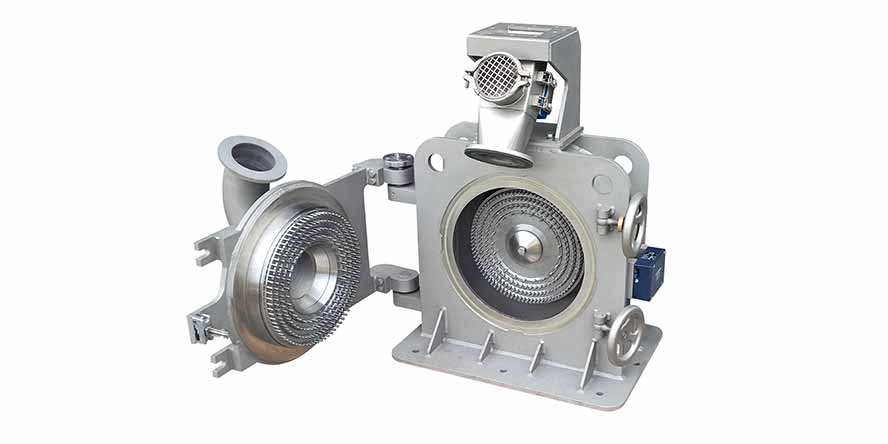
Impact Mills
We supply impact mills or complete milling lines for food and ceramics to the micro and nano scale. The offered milling plants include systems for storing and feeding the product to the mill, receiving the milled product, as well as screening oversize and returning it the mill. We also provide a system for transporting the product between individual devices, as well as a dust extraction plant. When the milled product is flammable and thus generates a risk of explosion, the mill or the entire plant is adapted to the requirements of the ATEX directive.
We also supply cryomilling plants using liquid nitrogen or dry ice. This technology makes it possible to cool the milled product so that to increase its fragility. This is particularly important in the case of melt, flexible, ductile or fibrous materials which cannot be milled effectively by traditional methods. An additional advantage of introducing inert gas (N2 or CO2) into the system is the reduction of oxygen in the installation, which in the case of grinding combustible products reduces the risk of explosion. In the case of milling herbs, cryomilling preserves up to several dozen percent more essential oils.

Contact our engineer
We will answer questions about: offer, technical specification, delivery, assembly.
Impact Mills – Examples of Equipment

Turbo mill
PERFECT WHEN YOU Are looking for a device for fibrous products Want to adjust the particle size at discretion Require a homogeneous grain size of the product

Blade mill
PERFECT WHEN YOU Are looking for a device that does not produce oversize grain Want to eliminate the screening unit from your plant Require a homogeneous grain size of the product

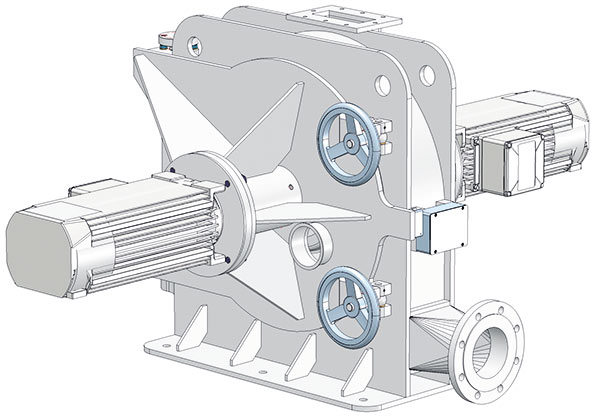
Disintegrating mill
PERFECT WHEN YOU Are looking for single mill for different products Want to grind abrasive products Require simple operation and maintenance
Additional design options
- Design in conformity with the ATEX directive
- Version designed for the food industry
- Cryomilling system
Impact mills – basic information
Pre-delivery tests
In order to ensure that the mill delivered fully meets your expectations, tests are carried out during which the product delivered by you is milled. We test different types of mills, their settings and the selection of milling elements. In this way, we guarantee that you will achieve the intended results under the given process conditions.
An air screener and laser diffraction are used to test the granulometric distribution of the tested products. In this way, it is possible to test the fineness of powders to a level of 0.2 µm.
Scope of delivery
Depending on your needs, we can supply just a mill that meets your expectations or complete a complete milling line. Regardless of the scope of our work, the selection of a mill can be preceded by tests that will confirm the effectiveness of milling. This way you can be sure that the milled product will meet your expectations.
- Disintegrating / blade mill or turbo mill (selection can be preceded by tests)
- System for storing and feeding the product to the mill
- Receipt of the product from the mill
- System for oversize screening and returning for milling (not applicable for a blade mill with
- an integrated screen)
- Close handling system
- Dust extraction plant
- Explosive safety system (when the milled product is flammable/explosive)
- Cryomilling plant (when the product is easily fusible, flexible, ductile or fibrous)
Disintegrating mill
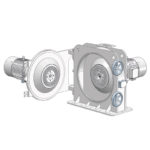
| Type | Capacity | Motor output | Rotor speed | Dimensions (LxWxH) | Weight |
|---|---|---|---|---|---|
| GSM 250 | 500 kg/h | 2 x 22 kW | 8900 min -1 | 135 x 80 x 80 cm | 700 kg |
| GSM 400 | 1000 kg/h | 2 x 38 kW | 6700 min -1 | 188 x 100 x 100 cm | 1200 kg |
| GSM 630 | 2000 kg/h | 2 x 55 / 75 kW | 3600 min -1 | 258 x 120 x 120 cm | 2500 kg |
| GSM 800 | 4000 kg/h | 2 x 110 kW | 3000 min -1 | 90 x 60 x 60 cm | 4000 kg |
Blade mill
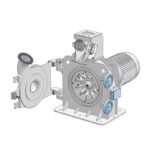
| Type | Capacity | Motor output | Dimensions (LxWxH) | Weight |
|---|---|---|---|---|
| GSK 315 | 500 kg/h | 26 kW | 110 x 75 x 90 cm | 430 kg |
| GSK 500 | 1000 kg/h | 37... 45 kW | 125 x 100 x 120 cm | 750 kg |
| GSK 630 | 2000 kg/h | 75 ... 90 kW | 150 x 120 x 140 cm | 1100 kg |
Turbo mill
| Type | Capacity | Motor output | Rotor speed | Dimensions (LxWxH) | Weight |
|---|---|---|---|---|---|
| GWH 250 | 500 kg/h | 25 kW | 12.000 min-1 | 125 x 100 x 100 cm | 650 kg |
| GWH 400 | 1000 kg/h | 52 ... 64 kW | 7300 min-1 | 130 x 120 x 120 cm | 1100 kg |
| GWH 800 | 2000 kg/h | 110 kW | 3600 min-1 | 190 x 180 x 180 cm | 2400 kg |
| GWH 1200 | 4000 kg/h | 185 ... 270 kW | 2500 min-1 | 250 x 230 x 240 cm | 4500 kg |
Advantages of air classifiers
- For the food industry, all joints in contact with the product are rounded and smooth
- Large manhole for easy access to the mill interior
- The machine can be explosion protected (explosion suppression) or delivered in explosion proof version
- Smooth rotation control by means of an inverter
- Direct drive transmission via coupling instead of V-belts
- Possible operation with liquid nitrogen or dry ice (cryomilling)
Impact mills – application
Impact mills are intended mainly for food and ceramic products. Their task is to comminute the product to the micro or nano scale. They are also often used for deagglomeration, i.e. breaking up lumps and clusters of a fine product.
Application of impact mills by industries:
- food industry
- mineral industry
- building materials industry
- production of paints and toners
- chemical industry
Application of impact mills by products:
- Proteins
- Fibre
- Cellulose
- Flavourings
- Phosphates
- Rubber (natural / synthetic)
- Tea
- Limestone
- Kaolin
- Collagen
- Fumaric acid
- Lactose
- Husks
- Methylcellulose
- PAEK
- PCV
- PEEK
- Pigments
- Plastic
- Polyethylene
- Polypropylene
- Polyurethane
- Flammable / explosive products
- Post-pyrolytic products
- Seasonings
- Sesame
- Corn starch
- Potato starch
- Soya beans
- Zinc oxide
- Vitamins
- Seaweeds
- Wax
- Herbs
Gelatine - Animal food
 Designing installations for bulk materials
 Explosion safety