



End-to-end design and launch of process safety systems
We take full responsibility for the entire scope: design, procurement, installation and launch of explosion and fire protection systems.
You enjoy efficient project execution, full control over the investment outcome, and optimized costs.
Why is it so hard to control explosion protection and fire protection projects?

Coordination of multiple contractors is hard – especially competence assessment and quality assurance.

Focus can be misdirected from maximizing risk reduction for people and assets to selecting equipment.

Contractor’s team can lack the necessary expertise and experience, which strains the budget and causes delays.
What does the EPC model change?
By working in the EPC (Engineering, Procurement, Construction) model, you transfer the burden of responsibility to a proven partner in explosion and fire risk management.
You work within a simplified management structure and greater control over costs. You also gain confidence that the installation fully complies with ATEX Directive requirements and fire safety regulations. By meeting insurers’ expectations, you can negotiate more favorable insurance terms for your facility.

A single, trusted
strategic partner

Project consistency
and better coordination of works

Increased control
over costs and schedule

Compliance with ATEX Directive
and insurers’ requirements
Optimize investment and operating costs
In the EPC model, we view your facility as an interconnected system – ensuring the investment is not only technically effective,
but also economically justified across the entire lifecycle of the installation.
CAPEX
You control investment costs from the very first design decision
OPEX
Your installation is more cost-efficient to operate and more reliable
To propose the most beneficial solution for the customer, we take into account not only the process and technical factors required to meet legal requirements.
We also focus on costs, including those incurred throughout the entire lifecycle of the solution (Total Cost of Ownership – TCO), not only the costs related to purchase and installation.
To calculate the total cost (TCO) of an explosion protection system, the following should be considered:
- Purchase costs of individual components
- Installation and commissioning costs of the entire system
- Periodic inspection costs
- Costs related to restoring the installation after system activation
Example: The customer wants to protect the air extraction system in a wood chip grinding installation.
Design assumptions:
The protection system must prevent flame propagation and explosion pressure release into the production hall. The equipment is already partially protected with two HRD units.
According to the requirements of the ATEX Directive, two types of protection systems can be applied in this case:
Proposition 1:
Explosion protection system consisting of 5 HRD units (2 existing + 3 new)
Scenario 2:
Explosion protection system consisting of 3 IsoDisc valves and 2 HRD units (existing)
In the first scenario, protecting the installation entirely with the HRD system would require the installation of three additional HRD units on three air extraction points. However, this would also require extending the existing ventilation ducts.
In the second scenario, no additional installation or assembly work is required. The cost only includes the purchase of IsoDisc valves and their installation. In both cases, the annual inspection cost would be comparable.
The factor that significantly changes the TCO between solutions 1 and 2 is the cost of restoring the system to operation after activation.
In solution 1 (5 × HRD), regeneration is required for all system components. In solution 2 (IsoDisc + HRD), only 2 out of 5 system components require regeneration.
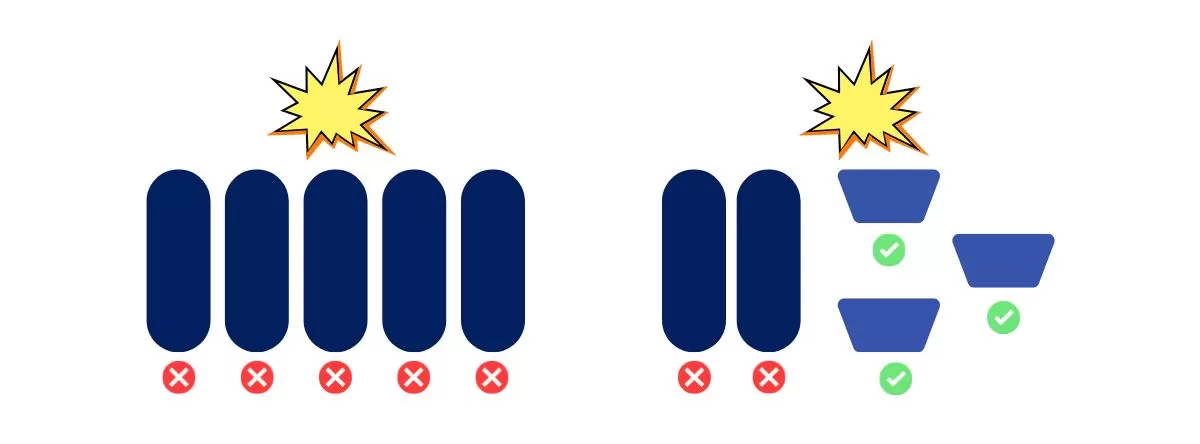
Fig. 1. Comparison of protection systems in scenarios 1 and 2.
Assuming that the cost of restoring one component equals X, it can be calculated that the use of IsoDisc valves resulted in savings of approximately 45%.
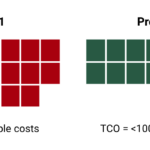
Fig. 2. Comparison of protection system costs in scenarios 1 and 2.
How does IsoDisc help reduce the total cost of an Ex solution?
First, it is a mechanical, reusable solution that does not require service intervention after activation.
Second, IsoDisc enhances the performance of the HRD system already installed on the mill. By closing under explosion pressure, the valve retains the extinguishing agent from the HRD bottle inside the mill, allowing the system to operate with full effectiveness while using a smaller quantity of extinguishing agent.
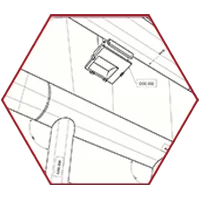
1. Concept and design
We serve as a technical mentor
for your team and all involved parties
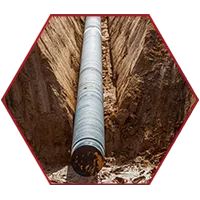
2. Earth- and construction works
We coordinate operations
at every stage
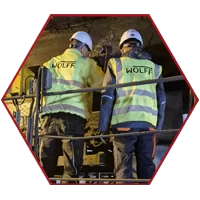
3. Procurement and commission
We deliver and install the system,
prepare documentation and train personnel
“We look at the facility from multiple perspectives. If a problem occurs during the project, we first develop a solution and only then involve the client. How about a reference visit? Our clients are happy to share their experience of working with us.”

Bartosz Wolff, CEO in GRUPA WOLFF
You are protected by our extensive insurance package
The quality of our work is a top priority, but we are prepared for the possibility of human error. Our insurance policy protects both us and your facility against unforeseen events that may result in losses.




![[“Rzeczpospolita” daily] - We Are Building a Safe Industry](https://www.grupa-wolff.com/wp-content/uploads/2016/10/rzeczpospolita-daily-we-are-building-a-safe-industry.jpg)